Monday, April 13, 2009

Is it Safe to Come Out and Sing?
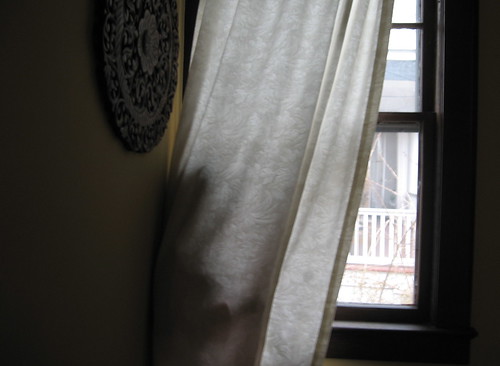
hidden at window

Life as jazz. Sweet improvisation. Singing one’s song for the world. Such thoughts should inspire, but ironically this chapter in Make the Impossible Possible made me tire of Strickland’s hopeful refrain.

True, he warns that 'choices we make are incredibly risky. They could lead to surprising and sometimes disastrous consequences.' And he reminds, 'when a jazz artist launches on a solo, he takes a frightening leap of faith. Every note, every phrase, every bit of color and texture he or she brings to the music is a risk that could backfire and make the player look like a fool. He could play himself into a corner. Worse, he could play himself out and find he had nothing to say.' But he concludes we can still achieve the impossible if we 'risk ourselves, our time, our careers for what we believe…' (p105)

In a world with all things being equal, this should hold true. And because Strickland comes from a world where all things were not equal, he should be a convincing voice (which, at some level, he certainly is).

But what if the world isn’t ready for our song? I consider a conversation that began over at Scot McKnight’s blog. I asked one of the participants to tell me more and let me share her thoughts here. This is what Barb answered, and I wonder what systemic dynamics work against her song.

Says Barb, 'I don’t like women’s bible studies because women’s groups seem to like to read women’s books. Prime authors include: Beth Moore, Joanna Weaver, etc. No men I know have ever read any of these books—even if the topic could be seen as gender neutral.'

She continues, 'The authors of these women’s books presume that women need woman-friendly examples to understand theological truths—that if it can’t be translated into cooking, child-rearing, house cleaning, or getting along with your husband then women just won’t get it. Favorite topics of books for women, by women, usually relate to personal devotion. A woman’s emotional experience trumps her intellectual experience.'

Finally, Barb asks, 'Where are those gifted women who write like Scot Mcknight (just one example)? He can proclaim a profound theological or biblical truth in a visual and conversational way—I’m thinking about ‘blue parakeets’ and ‘water-slides.’ I’m not really interested in what someone writes in her personal journal. I’m interested in how she (using both sides of her gifted brain) connects what she finds in scripture with her faith and her world. And I would love it if she would write about it in a detached enough way so it’s not limited to her gender’s perspective. I know that women are gaining ground in many areas, but when I look at the big stack of books by my chair—none are written by women. Is this a problem? What can we do?'

The song Barb is singing… is there a place in the world where it can be heard? Or do Strickland’s promises fall flat to women who feel this way? (Men, I’m interested in your response to this too. And, to everyone, it probably goes without saying, but I'd like a cordial discussion, since I'm thinking we all have our sensitivities regarding the issues Barb raises.)

Hidden at the Window photo, by Sara. Used with permission.

OTHER BOOK CLUB POSTS:
High Calling Blogs All that Jazz
Erica's Jazz and Balance

Reblog this post [with Zemanta]

Labels: , , ,

Thursday, December 18, 2008

No Need to Be Real About Jesus

Christ child

Sun pours through the car window as I wait. Girls are in piano lessons, playing holiday duets. Christmas is coming and I'm bundled, oblivious to the stress of the season for just this snippet of time, here in the car, in the sun before tomorrow's predicted storm.

Oblivious because I'm immersed in, of all things, the gift I bought myself for Christmas. The Jewish Study Bible. Not light reading for the hectic holidays. But I'm intoxicated.

The person who wrote the introduction is talking about the preeminence of story in Genesis and other parts of Torah. Genesis is not, he reminds me, philosophical proof or confession of faith or theological tract but story. (Hey, Scot, this reminds me of Parakeet too!)

Story is messy. It gets told from different points of view, it seems inconsistent at times, it is not rigid but fluid. It has, as the writer notes a high tolerance for different versions of the same event. I chuckle to myself and think about calling this post Torah 'n Me, because I realize I drive my husband crazy by a similar ancient-Near-Eastern approach to reality (it looks like I'm thinking inconsistently, Dear, but I'm just the Torah type!)

I close my eyes and think about a quote I read in A Profound Weakness...

... images of the birth of Jesus tend to focus on symbolic, formulaic aspects of the event because realism isn't essential in promoting story. Realism puts an event in time and place but doesn't necessarily point to the 'subplot', to the invisible. p.52

On the night before Christmas, we too will put realism aside. We'll think on the sweetness of God not with treatises but by biting into challah bread dipped in honey. We'll raise our makeshift tent (sukkah) and participate in the story of God's people seeking respite (the way the Israelites found respite in God in the desert). Each person will have a chance to sit in the shadows of the tent, smell and taste that bread, which a child will hand them, saying...

Surely goodness and mercy shall follow you all the days of your life, and you shall dwell in the house of the LORD your whole life long. Ps 23

And the one who receives the bread will say, Into your hand I commit my spirit; you have redeemed me, O LORD, faithful God. (Ps 31:5)

Each of us will bring our secret and not-so-secret stories to the tent. Knowing me, I'll close my eyes, feel the moment like it is the warmth of the sun shining, regardless of storms. And I'll feel bundled, like a child listening to a story before good night. Before good night and, in this season, before Merry Christmas.

POETRY FRIDAY:
RAP: Ache of Advent by L.L. at High Calling Blogs
Poetry Friday: Oasis at Erica Hale's
Six Christmas Poems at GoodWordEditing


Christ Child watercolor by Salvador Dali. Photo by L.L. Barkat.

Labels: , , , , , , , , , , ,

Thursday, November 06, 2008

How Cool is That: Scot McKnight, Atheists and a Renegade Bird

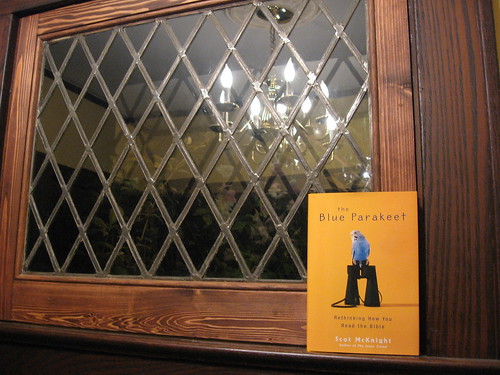
Blue Parakeet

A long time ago I interviewed Scot McKnight. I learned that he writes books based on burning questions. Soon after, I decided I probably should read one of his books, so I picked up The Jesus Creed and found a kindred spirit. He seemed to love all things Jewish, as do I.

But what probably impressed me more was how down-to-earth he was for a theologian (somebody please cry, 'Biased against theologians!' at this juncture). Now the cool side of Scot has come out full force in The Blue Parakeet: Rethinking How You Read the Bible.

Let's just say I was a little under the influence when I started the book (What are you thinking?! I was foggy-headed from residual flu syndrome). Yet I still managed to read half the book in about an hour.

That's because, flu or no flu, I could see that Scot had outdone himself in down-to-earthiness, pursuing yet again a burning question (this time one that reminds me of things my atheist friends are always saying, like... 'how come Christians pick and choose what they'll follow from the bible?') Scot turns that question into his main question, which is 'How, then, are we to live out the Bible today?' (sound familiar?)

He asks that question and then he (serious bible-commentary writer that he is) talks about a blue parakeet escapee, uses words like snarky, starts a chapter with a generous discussion of blogging, calls the Bible a set of wiki stories and remarks at one point, 'How cool is that?'

Even in a brain fog, I could see this was, to date, not only one of the most thoughtful books I've come across on how to read the bible but definitely the down-to-earthiest too.

Really, how cool is that?


Photo of Blue Parakeet by L.L. Barkat.


JUST BECAUSE:

Random Acts of Poetry: Prepare Your Mind With Culture and Poetry at High Calling Blogs

Random Acts of Poetry: Morning Comes... at Erica's

I was so pleased to see Sara and her family in the New York Times. How cool is that?

Labels: , ,