Monday, April 07, 2008

Hard Commodity in the Blogosphere
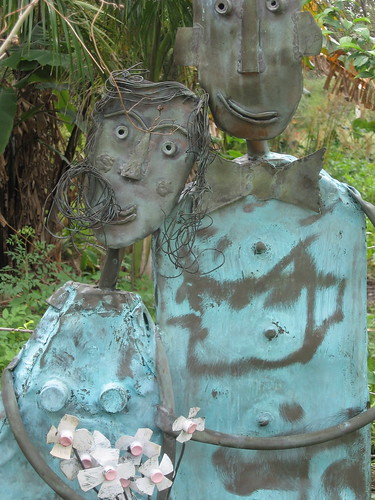
Together

I am still making my way slowly through Krista Tippett's Speaking of Faith. It's as good as any story, the way it moves forward through the framework of Tippett's life while discussing science and faith, life and death, doubt and devotion.

Last night, I related to this passage quite keenly...

I have always been invested in ideas, in words, in the presentation of words. The people on Wooster II took me out of my head. They taught me the gravity of nonverbal presence— of eye contact and touch. I learned to accept silence, not to fill it with talk, to respect the immensity of what eyes and hands alone could express. The writings of Margaret Spufford came back to me on that dementia ward— the notion that in the end, the reality of God is most powerfully expressed not in ideas and proclamations but in presence. I sometimes felt that presence palpably in silence and the inchoate, searching bond of raw togetherness between us. p.118

As I considered Tippett's words, they resonated. And they pained me, regarding my blog relationships. What, really, can I do to be present in this way, this raw togetherness way, over a bunch of wires and through signals? Not much. I can only wait for the chance to be together, in some cases again, in other cases for the very first time.

Not that I find no community here. I've said before that I think I do. But presence is a hard, perhaps impossible commodity to truly find in the blogosphere.

Together Photo, by Sara. Used with permission.

LL IN OTHER PLACES:

At the High Calling this week, Don't Give Your Gifts a Haircut

PLEASE WELCOME:

A post on a lighter note, from Long Island Express Girl

Thoughts on silent words, from Janet Collins' OnWords

Jane Emmert at Inspiration and Art

Labels: , ,

Monday, March 31, 2008

I Did Not Try

striated rock

The night before I went to Mount Hermon, a dear friend of ours passed away quite unexpectedly— a massive stroke, in a young man. The day I returned, I had news from another friend, whose sister just lost her newborn son. My trip, so life giving in many ways, was bookended by death.

Yesterday, a wonderful speaker, Jason Gaboury, came to our church. He talked about what it is like when we have a bad day, a bad year, or even a bad decade. I realize that when it comes to the issue of death, I, along with my community, have had a bad decade, striated with seemingly senseless deaths (all death of course is senseless in its way, but we more readily accept the passing of a person who has had a "fullness of years").

Gaboury, looking at the book of Daniel, asked us to consider whether we could see God in the midst of dark times of captivity. Indeed, he urged us to listen for God's footfall in the shadows. Somehow this came together for me in the words of Krista Tippett, regarding the execution of Dietrich Bonhoeffer "just weeks before the collapse of the Reich."

She says, "His death seemed to me a puzzle, a piece of religious irony. Wasn't this a failure of God, a rebuttal of the very idea of God? Yet some irrational aura of triumph— defying my sense of time as flat and contained — surrounded Bonhoeffer's legacy. I could not fathom this... and I did not try." (p.42)

In her words, I realize that I am two-dimensional when it comes to trying to understand these matters. My sense of time is flat and contained. I cannot fathom the whys and hows, the shape of death and the mystery of eternal life that transcends it. And, in her words, I find the comforting thought that it is okay to put my head down and weep. To say, along with Tippet, "I did not [even] try."


Striated Rock photo, by L.L. Barkat.

RELATED:

LL's Tired of Dying

Christine's Gabriel Gifford Scheller

Labels: , , ,

Monday, March 03, 2008

Speaking of Faith

Nature's Abstract

I admit I'm only in chapter 2, but I already love Speaking of Faith. The final test of my enthusiasm will be if I finish the book (which as I've mentioned before is a rare thing for me to do).

Tippett grabbed me in the first chapter, saying, "I believe what most Americans want, whether they are religious or not, is for the religious voice in our public life to be more constructive— to reflect the capacity of religion to nourish lives and communities." (p.2)

Though "some say... that religious passions are the cause of our culture's worst divisions, and a threat to democracy here and abroad", Tippett asks us to consider the truth that is "more broadly and deeply rooted in the human psyche and spirit." She describes this truth as a "tapestry unfurled, both ancient and in progress like the whole of creation... that arguments cannot contain." (p.4)

These words resonate with me. I can and sometimes do engage in argument for religion (argument in the formal sense of the term, not meaning "quibble"). Argument has its place. But there is so much more than argument through which to explore the claims and nuances of religious experience.

I think this is why I was so taken with that picture in Chronicles, of the full spectrum of players needed to "show" and "declare" the glory of God. Because, as it goes, some of the greatest speech on faith is not speech at all.


Nature's Abstract photo by Sara B. Used with permission.

Labels: , , ,