The Gift: Take, Eat, this is My Tweet-- hospitality on Twitter
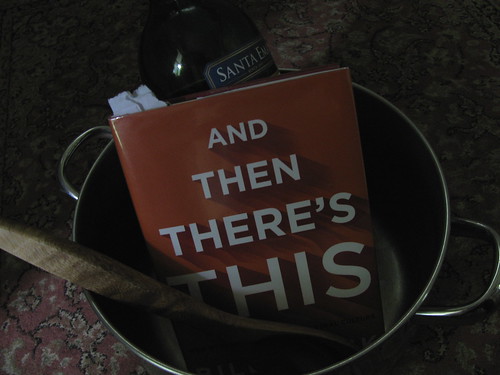
'Honey, come and try some viral-marketing broccoli rabe,' says a woman to her boyfriend.
The context? Bill Wasik, author of And Then There's This: How Stories Live and Die in Viral Culture has just removed the plastic-bag-cooked-veggie from the microwave; he's promoting the bag as part of a word-of-mouth effort he signed up for on-line. This is the world of viral dreams, where businesses capitalize on 'media-consuming individuals' in hopes of creating 'community' that will sell their products.
But corporations are only tapping into a reality that exists for many who move and shake on-line. These are the 'sub-culture [who have] the mind-set of the marketer, drunk on numbers, single-mindedly obsessed with gathering attention, engineering sudden spikes.' They are the 'individual consumers...learning and refining the tricks of manipulation for themselves— where they serve as secret agents inside their own crowds, totaling up mentions and page views, sifting through their troves of data in a scurrilous search for gold.'
In other words, we are a tweeting, blogging, story-churning narcissistic cyberbunch, asserts Wasik, and who knows what effect this will ultimately have on culture?
Wasik's conclusions are only slightly less narcissistic than the cybertrends he observes.* In a kind of secular-spiritual-practice approach, he recommends quiet times, techno-Sabbath, self-reflection, and delaying gratification (by waiting for a topic to die down before reading about it). He asks us to be judicious controllers of what we take in, mostly to preserve our sanity and productivity and possibly to grant reason to our politics and greatness in our art. Any mention of true community and grace-engagement seems absent, as he urges us towards a corrective of partial 'disengagement.'
Enter The Gift, by Lewis Hyde. In speaking of gifts, he considers three levels at which they can function: the ego-of-one (which is self-gratification), the ego-of-two (which is reciprocal and best exemplified by lovers) or a full circle scenario that is unlike many married couples who 'get just so far in the expansion of the self and then close down for a lifetime, opening up for neither children, nor the group, nor the gods.'
In a sense, Wasik's Internet antidotes speak to dealing with the ego-of-one. But can *disengagement* alone move us towards higher levels of gift-giving? Towards reciprocity or full-circle giving? Maybe for that, we need to consider grace-engagement, a kind of cyber-hospitality modeled on tried and true off-line social behaviors.
For simplicity's sake, I thought we might focus on the increasingly popular Twitter world. However, if you tend to move more actively in the blogging or Facebook world, I invite your observations in those arenas. I don't think I've reached an adequate hospitality model quite yet, but here are some questions I've begun to ask myself about the act of tweeting...
1. How often do I tweet? If I spoke that much at an actual party, would I be monopolizing the conversation? Would I be viewed as a self-focused self-promoter?
2. Do my tweets tend to focus on *me*? As a journaling tool, focusing on myself can be positive, but how would such inward-focus be viewed in the average off-line conversation?
3. Do I tweet about the good stuff? Comparing this to off-line, am I just the gossipy tidbit type (sometimes fun and can serve a purpose) or can I also be counted on to move the conversation to refreshingly humorous or profound places?
4. Are my tweets usually monolog? Or do I engage in dialog? At 140 characters per entry, dialog is no simple matter. Still, am I talking AT or WITH other people?
5. Do I celebrate others' successes in my tweets? (And here I must thank Bradley Moore for retweeting my self-focused tweet on how I received an unexpected advance because Stone Crossings is being translated into Korean! Oops, pardon that temporary descent into narcissism :)
6. Do I think twice before tweeting on a bandwagon? As Wasik notes, he has seen the 'day-to-day destructiveness of the Internet churn, of the manufacture of nanostories with little regard for their ultimate truth.'
7. Do I tweet-dialog mostly with one other person? As in off-line life, it's good to focus on one or two friends sometimes, but in a social context that can border on the ego-of-two which never widens the circle.
8. Are my tweets always directive, statement oriented? Or do I sometimes ask questions, thus encouraging others to think and respond and add their wisdom or humor to the conversation.
All righty. Take, eat, these are my thoughts on tweeting. Now I'll sit back and wait for the bread and wine you'll bring to the table. And together maybe we can feed a wider world.
And Then There's This, photo by L.L. Barkat. *Overall, I enjoyed Wasik's book; I attribute the nature of his conclusions partly to the stage we're at with this whole 'social media conversation'; others like him, including those in the Christian community, have offered similar antidotes that rely on disengagement. As the conversation continues, I expect we'll eventually see a call for other kinds of solutions that favor what I've termed grace-engagement. For an article that begins the call in this direction, check out Loving Your On-Line Neighbor as Yourself, at Catapult.
OTHER BOOK CLUB POSTS:
High Calling's Laish and the Silo Effect
Thanks to International Arts Movement, for linking to our discussion of The Gift.
OTHER SEEDLINGS POSTS ON 'THE GIFT':
When Did You Labor, or will Sabbath help your gift go viral?
Womb, Harlequin, and License Plates: The Gift, 1
RELATED:
Trust Word of Mouth, at eMarketer
Loving Your On-Line Neighbor as Yourself, at Catapult
The Rise of the Nanostory, at Freedom to Tinker
Nanostory, at Tangzine
TOTALLY OFF TOPIC:
My First Giveaway, at Billy Coffey's.
![Reblog this post [with Zemanta]](http://img.zemanta.com/reblog_e.png?x-id=386f00a8-0a0d-4cda-9208-27f6e0bd3a84)
Labels: And Then There's This, Bill Wasik, culture-making, God in the Yard, hospitality, Lewis Hyde, spiritual practice, The Gift, Twitter, viral culture, Viral marketing, word of mouth
posted by L.L. Barkat at 8:00 AM
13 comments