Serendipity.
I love that word. And I love when it happens to me.
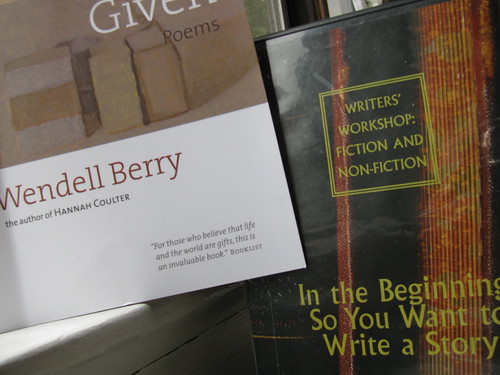
The other day I ordered a book from the library, but it turned out to be a 6-DVD series on writing that was the exact resource I would have ordered for my daughter, had I known. Lately, she's been filling notebook after notebook with stories and poems, and she has a lot of questions that one writer alone (me) can't really answer.
Enter the DVD series: published writers, fiction and non-fiction, talk about everything from how we word-people get inspired, to dealing with character development, writer's block and rejection. (Since these series are EXPENSIVE, you'd want to get it from the library; it's called
Writer's Workshop: Fiction and Non-Fiction and is put out by
Films for the Humanities & Sciences I didn't see it on-line, so maybe it's no longer available for sale, but perhaps in the stacks one could find it).
My daughter has begun watching the series and appreciates the various perspectives. Some writers don't believe writer's block is real, for instance (and it is better for her to hear that from someone else, since I already tried the delicate advice, JUST WRITE!). Some of the writers think ahead about the market and others say they just write for themselves. Almost all of them agree that the best way to be a good writer is to first be a good reader.
What struck me, in listening to these people talk about how to write and in hearing them read their own words, was how many good writing skills can be practiced by reading and writing poetry. No one was saying that outright, but they talked about the need to focus on details, encouraged us to learn language rhythms and slow ourselves down when experiencing texts in order to feel the impact of words, and discussed the need to play around with and free one's voice. Poetry is the ideal context in which to hone these skills. Think about it. Great writers like
Wendell Berry and
Mary Karr don't just write essays; they write poetry too.
The problem is that too many of us think poetry is for lovers, kids, English-class students, or high-minded people; we don't realize that reading and writing poetry is a form of writer's weight lifting. It challenges our word muscles, pokes at our weak spots and dares us to strengthen them in a way that meandering prose opportunities do not. Once, a friend of mine (who has written 36 books) said the best way to practice writing is to write 'short'. We could do that by writing ad blurbs (I served some time that way), or we could really flex our muscles and start lifting words into poems.
So why not take
Laura's challenge, maybe win a free book while you're at it, and get those writer's abs in shape?
Berry Book and DVDS photo by L.L. Barkat.
THIS 'N THAT:
Fun feature of the basic me at
Andrea's placeCheck out this great little new blog,
Children of Eve.Book Giveaway: Stone Crossings, at Holy Experience
Labels: becoming a better writer, poetry, writer's block, writing life, writing poetry


![Reblog this post [with Zemanta]](http://img.zemanta.com/reblog_e.png?x-id=352da7df-c0e2-4a7e-875b-250e1d274b92)