Monday, November 08, 2010

On, In, and Around Mondays: Finding Our Place Within
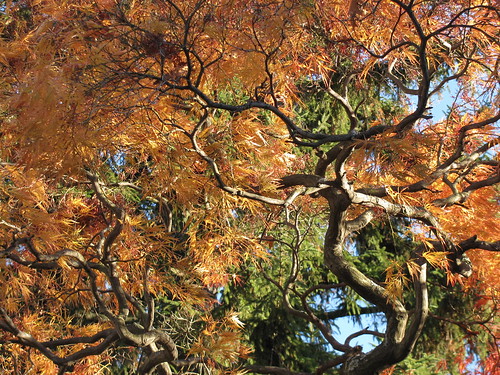
Japanese Maple

The place I am this morning is tired.

Maybe it's the time-change. More likely it's that the day ahead is too small for what I need to fit into it. Laundry, home schooling, business, preparing a talk for tomorrow.

Yesterday I did nothing much, because I knew the place I was in. But my daughters and I played a little poetry game.

"Bring a notebook and a pen to dinner," I said.

"That sounds mysterious. And exciting!" chimed my Littlest.

We borrowed lines from Elizabeth Bishop, to use as our own first lines. Then we played with various catalog techniques... repeat words at the beginning of the lines, repeat words between lines, repeat words at the end of the lines.

I can't say I wrote anything really worth sharing. My Littlest also found the exercises difficult. She and I are the same kind of writers; we write from a place of personal rhythm. Even so, I imagine that my Littlest and I were skill-building, though our poems-of-the-moment suffered. But my Eldest was empowered by the experience. And all of us agreed it is a marvelous way to play with words.

Here are two poems from my Eldest, then...

A washing hangs upon the line
a washing rain engulfs it.

*

With ten big beads,
one a pin for a dress of beads,
black and red beads,
one bead lost in a lawn where beads
of dew still stand, two beads
blue shiny earring beads
three beads forgotten in a box of buttons, only beads
to attest to ten big beads,
now three beads left, beads
yet unfathomed, unexplored, unused. Beads.

— by Sara

Japanese Maple photo by L.L. Barkat. Poems by Sara, used with permission.

---

On, In and Around Mondays (which partly means you can post any day and still add a link) is an invitation to write from where you are. Tell us what is on, in, around (over, under, near, by...) you. Feel free to write any which way... compose a tight poem or just ramble for a few paragraphs. But we should feel a sense of place.

Would you like to try? Write something 'in place' and add your link below.

If you could kindly link back here when you post, it will create a central meeting place. :)

This post is also in honor of Random Acts of Poetry.

Labels: , , ,

Tuesday, October 26, 2010

I Am Currently Jealous of Walt Whitman, Robert Desnos, and David K. Wheeler

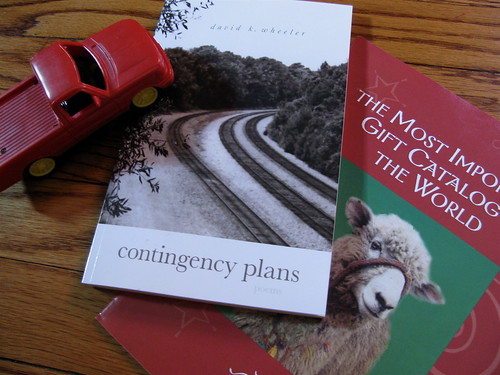
Contingency Plans Gift

How hard could it be?

I was reading about a poetry technique called cataloging. It seemed simple enough. Until I tried it. The technique uses word-repetition to create a sense of praise (for the object, concept, or beloved). Or sometimes to create a sense of magic or prophetic voice.

How hard could it be to repeat words and make a good catalog poem?

Whitman did it in Song of Myself...

Have you reckon’d a thousand acres much? have you reckon’d the earth much?
Have you practis’d so long to learn to read?
Have you felt so proud to get at the meaning of poems?


Robert Desnos did it in The Voice of Robert Desnos...

the one I love is not listening
the one I love does not hear
the one I love does not answer


David K. Wheeler did it in On Restlessness...

There was never a time that I knew everything.
There wasn't a night I wanted you to lose sleep.
There are some words you can say with a blink.
There are nights I wake up curled on the floor.
There are appliances that refuse to operate.
There are solutions that don't have a question.


But in the end, I could not write a catalog poem. Not to my satisfaction. So I wrote this poem instead...

Poetry 101: Cataloging

All day I have been tapping out words, trying to catalog
my love for you. I've been sketching where the type would go
and the images— Bratz, Tonkas, a red truck that takes off
without pushing, after just a bit of pre-winding against a warm oak floor.
I've been shaking words into phrases that could go under little squares
on catalog pages; squares of silken ties, underwear, tube socks
and, surprisingly, Martha Stewart pillows (throw, in all the latest
catalog colors; this year it's yellow, which is far too bright
for how I feel... a catalog should never steal my love by pushing
the commercial sense of hue and shade on I-love-you; I tried those
too, you know— notebooks stamped I love you, with bubble hearts,
balloons, and ungodly purple butterflies). No matter how I listed,
squared, adjusted like a quintessential Sears, nothing seemed to finally do
what a catalog of broken lines should somehow, without measure, do.

This post is in honor of One Shot Wednesday.

Labels: , , ,

Monday, May 04, 2009

A Golden Chain: Writing in Form

P1000119

Last week, over at High Calling Blogs, I went on about poetry and elitism— saying (are you surprised?) that we need more room in this world for word celebration. In response, Megan Willome dropped a marvelous poem in the comment box, about how teachers can kill our love of poetry with too much emphasis on form. This reminded me of a T.S. Eliot class I took at NYU; I thought I'd never recover from the relentless focus on every sound, symbol, line break and pattern.

But if you know anything about me, you understand that I love to quibble with myself. So even though I offered the prompt 'I look at you, as if for the first time...' (see the HCB post for more details), I didn't take myself up on it. Instead, I decided to confront my distaste for writing in form and prove that it doesn't have to derail beauty or mercilessly constrain a poet.

Using The Making of a Poem, I read about a form called the 'villanelle.' I thought it was interesting that the authors said this form prevents the telling of a story, because of the way it uses repetition (notice how line 1 is repeated at the end of every other stanza and line 3 is also repeated and then both are repeated as a pair at the end of the poem).

Also, there's a rhyming pattern that switches back and forth. Poets call that aba. Don't worry about it. Just be a detective and find the rhymes yourself; it's more fun that way. Notice that there are 5 stanzas of 3 lines and the 6th has 4 lines. Who comes up with this stuff? Well, apparently Italian farmers had a lot on their minds when they made up songs in the fields, because that is how the villanelle was born.

Here's my go at one, dedicated to a friend who is currently traveling in Sudan.

'A Song of Sudan'

You travel past equator 'til
the sand whips over day
and night descends quite still.

Cloth veils the face of women ill
and well (you cannot say);
you travel past equator 'til

the Nile snakes its shrill
regret of war, while battle is at bay
and night descends quite still.

By morning, sun begins to stalk and fill
the cracks of every hiding place
you travel past equator 'til

deep griefs unravel will
to rebuild shattered clay
and night descends quite still.

An ibis eyes you, dips her beak to kill
some silver flash like bullet play
you travel past equator 'til
the night descends quite still.

(This poem was later published in InsideOut: Poems, International Arts Movement, 2009.)

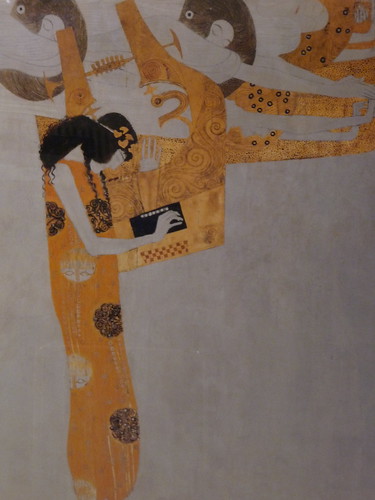
Gustav Klimt's Lady Poetry, photo by J Barkat. Used with permission.

MORE POETRY:
LL's daughter's The Garden Still, two villanelles and a sestina
Reblog this post [with Zemanta]

Labels: , , , , ,

Thursday, April 09, 2009

For Easter: In Lieu of the New York Times

Clover

Where do poems come from?

Sometimes I have a clear vision for a poem and it's simply a matter of pursuing it. Other times I wake up with half a poem in my head and all I need to do is take time to finish it. Then there are those moments of greater discipline when I begin in trust, with an arbitrary image, and hope that a poem will agree to be forged. That's how this poem was created, using the prompt If words were... and an image I settled on without any particular vision for where it might take things: clovers.

Though the poem could be given to any number of people in my life, I eventually saw its potential as the words of God to me (and to you) this Easter... an invitation, yet again, to "taste and see that [he] is good."

'In Lieu of the
New York Times'

If words were
clovers
I’d pluck mine
and lay them
at your doorstep,
retreat to shade
of oak,
watch you become
a child again,
poke past purple
spikes, nip tender
white tips with
teeth, freely sip
raw sugar, lick
your lip.

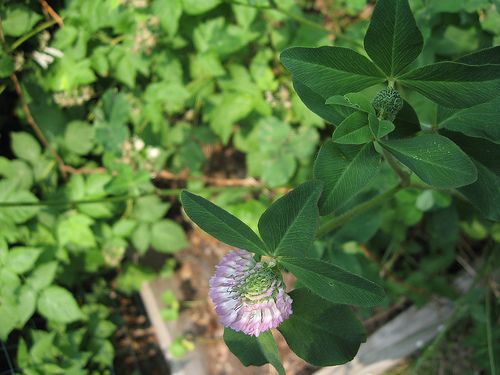
Clover photo, by L.L. Barkat.

MORE GOOD FRIDAY/EASTER POETRY:
Goodwordediting's Surprised by a Styrofoam Jesus
Marcus Goodyear's unconventional Good Friday poem God Breathed, at Catapult
Jim's Yet Still
Ann's Necessary
High Calling Blogs' RAP: Eating Our Words on Good Friday
Scott's An Easter Poem

MORE ON EASTER:
Byron Borger's Hard Lessons, review at Catapult
High Calling Blogs Bottleneck in the Communion Line
Reblog this post [with Zemanta]

Labels: , , ,

Saturday, January 31, 2009

Writer Must See

Dried Fern Detail

I write a poem. My sister sees it. Memories flood— creek days, lilac days, pine and pond days. So she writes within my poem, turns it on its side. Suddenly, surprisingly, deliciously, a different slice of past is brought to light. A past I lived but did not remember from that perch in the fir (she was a climber, never I).

Then sweet Ann says this (and I cannot resist putting it in poem dress)...

Sandra and you
are twins... words
in the womb
waters that you both
have birthed here,
sister lines.

Breathtaking.
You both
have this seeing thing
in your genes...

Ann's words happily recall for me lines from others (and from Ann herself) who have spoken about my book Stone Crossings. Like bookseller Byron Borger, who said, '...I want to write about something else, one of the best books I've read in a while...She has a great eye for details, and a luminous style that revels in God's presence in the day-to-day.' Or Eugene Pratt, who remarked, 'She possesses an eye for striking detail...' And Ann Kroeker who mentions, '...she offers...beautiful detail...'

All this talk about detail, about seeing, sets me to pondering. Maybe seeing is the beginning of good writing, whether poem or prose, comedy or tragedy. Perhaps the first task of the writer is to see or hear, taste or touch, inhale the moment that is right under his (or her) nose. Having done this, the challenge is not to let go of the memory in favor of abstract words.

Let's ponder this together, with an example from my own work. In 'The Watching' (previous post), I originally wrote...

of a mother's mud-patched efforts
to provide comfort and nurture.


But no. Is that what I saw as a child, when I leaned to look into the robin's nest year after year? Can you see comfort and nurture? This is abstractness and has little right to be in a poem (or good writing of any sort). So I went back to my memories and saw the single blue egg that would prematurely crack, ooze yolk. The single egg that was lost despite robin-mother's hard work. And I wrote this instead...

of a mother's mud-patched efforts
to prevent a deadly cracking.


To say cracking is a better choice. It is something we see, understand means death. (Now I think perhaps I needn't have even said deadly, so inherent is death in the cracking itself). Another nice thing happens with the new choice. Cracking has a rough sound that hints at the ominous nature of my childhood setting.

So here is the writer's challenge:

see, taste, touch, smell, hear. Write it down. Excise the abstract where possible. Choose words with sounds that mirror meaning. Suddenly, deliciously, a slice of life is steaming, fragrant, golden, mouthwatering.

If you'd like to try this, here's a line to open (or close or middle) with...

I close my eyes and I can still see... [try to insert a single setting here, or person, or activity, so as to make yourself focus on detail]

Try a short piece. A poem or a vignette (no more than 200 words or so). Take the writer's challenge outlined above. Publish it at your blog and let me know and I'll link to you. Then I'll choose a few to feature at The Seeing, at High Calling Blogs. Try to finish up by Thursday afternoon if you want to be eligible for a possible HCB feature.

I close my eyes and wait for what you will lift from the past... pressed white linens and shined silver, fishing rods and emerald dragonflies, the cracked window at the back of the red shed, lilacs pressed by chubby childhood fingers.

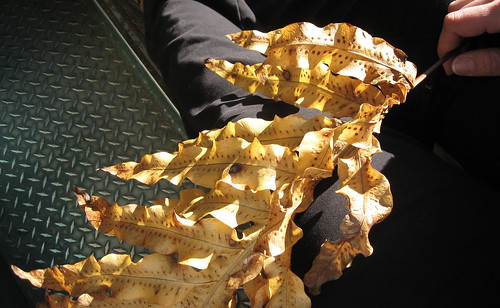
Dried Fern Detail photo, by L.L. Barkat.

YOU TRIED IT:
Beth's Back from the Clinic
Rebekah's Little Girl
Katrina's The Hayloft
Laura's The Long Ride Home
Rain's Innocence Hill
nAncY's ~eyes closed~
Joelle's Pinto Beans
Hope4Today's I Close My Eyes and I Can Still See
Tina's The Journey
Sarah's Life is Not All About Forward Motion
Nikki's Seeing Detail, Writing it Down
Liz's I Close My Eyes
Unknown Contributor's vignette Pink Frilly Underpants
Joy's Seeing
Erica's Grandmother's Kitchen
Ann's Make Pearls

RELATED:
LL's Stand Still, Let Go, and See
Katrina's I'm Seeing, Noticing
The Seeing, at High Calling Blogs

Labels: , , , , ,

Wednesday, January 28, 2009

The Watching

If Memories

On Monday morning, I opened up the Seedlings living room for poem play. Who knew how many hidden poets were among us, ready to respond if only prompted with a few words...

If memories were sparrows

Of course, since then, I too have been intrigued by those words. What might I make of them? This is what came...

'The Watching'

If memories were sparrows,
mine would gather behind
a house half finished aluminum

sided against the landscape, windows
glazed from the inside out with smoke
of cigarette and venison burning.

They would crowd in lavender lilac,
above the intersection where each year
a robin laid impossible blue eggs,

one of which it seems would always
break, sully the perfect roundness
of a mother's mud-patched efforts

to prevent a deadly cracking. Sparrow
memories would rock limbs, tremble
leaves, blot out the threat of rain

while brown haired girls peered over
rim of tight worked straw to watch
a miracle of twin eggs coming to birth.

[UPDATE: Tonight, my sister Sandra sent me this beautiful poem— another lift, a twin, a side window. Makes me wish for a Stone Crossings of sorts from her own hands.


'Summer'

If memories were sparrows,
mine would cluster in the thick
of forest pine bravely stretching

high into the skyscape, branches
broad and twisted, gently worn from
passage of youth’s strong limbs.

They would crowd in treetop perches,
staring down on murky pond face
where fallen cones go to sleep

with black tadpoles whose bodies
morph, from slippery slivers to
croaking fullness, reminding us

to avoid an angry wind. Sparrow
memories would chase salamanders
orange and dry under summer sun

while brown haired girls twitter
bare feet squishing in the mud
that sparkles with broken glass.

— Sandra

Thank you ALL, for taking words that began here and stringing them with hopes, humors, dreams, imaginings and longings of your own. There is still time if you have not yet crafted a poem or want to add to our communal poem (please post all entries by Thursday night, either here in the comment box or on your blog). Then, on Friday, we will have our grand finale at High Calling Blogs.

Katrina's If Memories Were Sparrows
23 Degree's If Memories Were Sparrows
Nikki's trio of memory poems
Sherri Watt
Nancy's poem
Laura
Mom2Six's I Start, You Finish
Laure's The 10 O'Clock Evening Hour
Rain's If Memories Were Sparrows
Marcus
Heather, of Off the Beaten Path
Lorrie's If Memories Were Sparrows
Erica's If Memories Were Sparrows: Playing with Poetry
Joy's The Great Poem Caper
Prairie Chick's Memories
Joelle's If Memories Were Sparrows
Lynet
Kim's If Memories Were Sparrows
Ann
Lucille
Lore
Daune's If Dreams Had Wings Like a Sparrow
Emily's If Memories Were Sparrows
Bought 'As Is' If memories were sparrows...

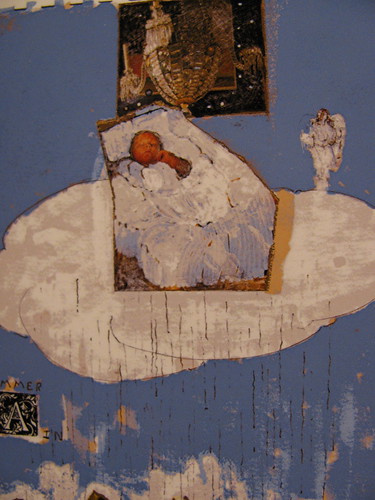
Memories, mixed media art by Gail Nadeau. Used with permission.

RELATED:
High Calling Blogs RAP: Poem Play

Labels: , ,

Friday, January 23, 2009

Writing a Poem Isn't Rocket Science

Summer Rain

I realize that I write with different processes depending on the piece. For instance, some projects are just perfect for a little preliminary long-hand work. But others?

Take me and poetry.

I cannot write a poem in longhand. It just flops on the page. Too limp in expression. Too wordy. Too... not enough of what I want from a poem. So when I write poetry, I kiss pen and paper goodbye and enter the world of daydreams. I stay in bed just a little bit longer, pretending to be asleep. Or I exercise. Or drive. I do things that take me away and let my mind present images in rapid fire. I turn these images upside down and backwards, try on words and more words until they start to feel right. Sometimes I do this directly from the keyboard too. Let me illustrate the process with a poem for today. And also say that that process is not as clean as this, but you get the idea.

Step 1: Choose an Object, Person, Event, Experience

couch


Step 2: Daydream in Images (today it happened before I turned out of bed and now I'm adding to it here at the keyboard)

paisley, tattered, dark green, first apartment, sitting before fire with spouse, cuddling, nursing babies one and two, birthday guests, tortilla chips and salsa, home-made spring rolls, new nephew staring at design, kids bouncing on, kids leaning over to look out window and wave goodbye to daddy, shredded


Step 3: Consider Fate and Dig for Meaning

This couch is destined to be replaced as soon as possible. If we'd spent more money on something lasting, we could have held on to it for the life of our marriage, maybe even passed it on to children or grandchildren. As it goes, we'll be tossing out a piece of furniture to the sidewalk. The garbage truck will come and crush it, taking some part of our memories with it.


Step 4: Think in Verbs

toss, crush, drop, lose, mourn, release, turn


Couch

If we had known,
considered,
when we slapped
down a few hundred
dollars for dark green
paisley with a hidden
sleeper, if we had seen
it coming, the shredded
chintz, tatters, depressions
and how we would not
care to repair it because
it's too short for my
husband to sit on
anyway (hurts his back,
he says), then maybe
we would have dug
a little deeper, sacrificed
more to save for something
lasting, to keep through a lifetime
and pass on to children,
grandchildren. As it goes
we need to toss birthdays,
stray tortilla crumbs
sweat of bodies
embraced, stolen kisses,
accidental spray of suckling
milk, toddler bounces
and goodbyes to daddy at the
window. If we had but known.

Voila! A poem. Some images and verbs came through. Others slipped away. New ones appeared as the poem grew. Daydream time: about 20 minutes. Actual composition time: about 5 minutes. Writing a poem isn't rocket science, after all.

If you try this process and write a poem, let me know about it and I'll be happy to link to you.

POETRY:
High Calling Blogs' RAP: Dreaming in the Comment Box
Erica Hale's RAP: On the Fridge
LL's January
Laure's 11 O'Clock Morning Hour
Ann's homecoming poem
Katrina's In the Stillness


Summer Rain Mixed Media art by Gail Nadeau. Used with permission.

Labels: , , ,